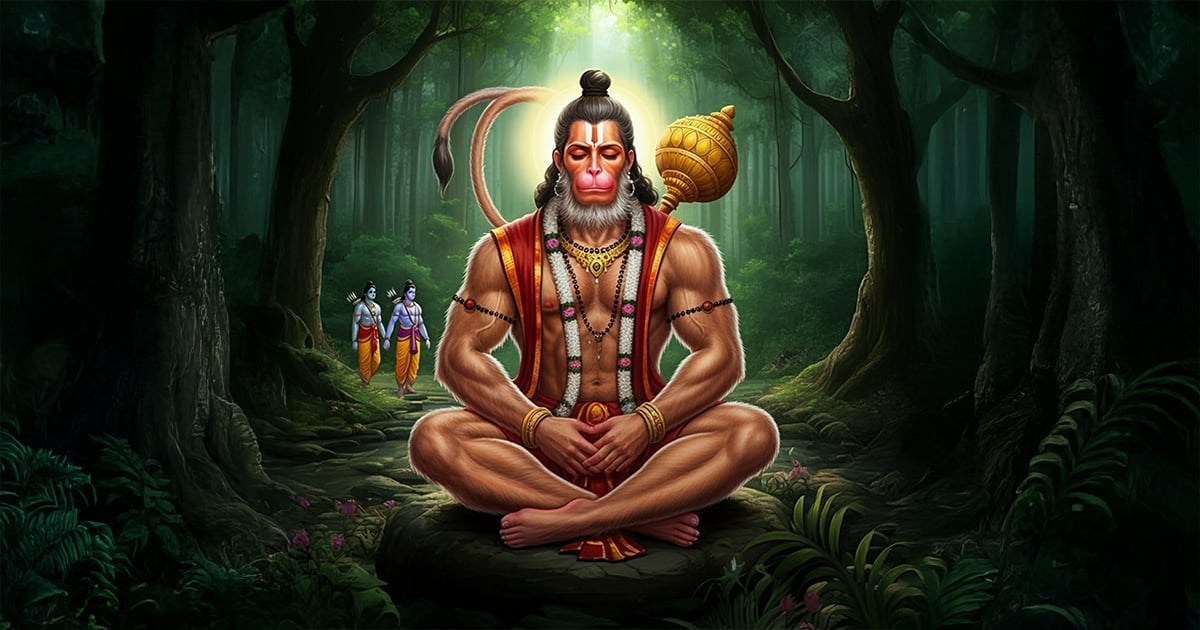
“Humans can evolve to the level of Hanuman. Hanuman is not a God. He is a human who evolved to a level wherein he represents qualities of omniscience, omnipotence, and omnipresence.” Dr. Pillai
Hanuman worship occupies a distinctive place in spiritual traditions because it does not merely venerate a deity; it presents a model for what human consciousness itself can become. In Dr. Pillai’s teachings, Hanuman is not approached as a distant mythological figure, but as an archetype of evolved intelligence, disciplined breath, selfless service, and mastery over limitation.
This approach shows that Hanuman worship is not only about devotion or faith. It can also be understood as a way of studying how higher intelligence works through the human mind and body
Hanuman: Archetype of Human Evolution
“I am going to talk about human evolution itself and the role played by Hanuman in the process of human evolution.” – Dr. Pillai
Within the Vaishnavite tradition, Hanuman represents the highest evolutionary potential available to human beings. He is described as a being who transcended ordinary biological and cognitive constraints while remaining deeply committed to service. According to this view, humans may not become God, but they can evolve to the level of Hanuman—an intelligence marked by clarity, power, fearlessness, and compassion.
Hanuman, therefore, stands as a corrective to spiritual models that emphasize withdrawal from the world. His life demonstrates that advanced consciousness expresses itself through action, responsibility, and service rather than renunciation alone.
The Principle of Seva (Service)
“He represents total service to humanity – how human beings can evolve to a life free from suffering, free from ignorance.” – Dr. Pillai
In Hanuman worship, service is not an extra moral idea—it is central. Hanuman’s intelligence cannot be separated from his willingness to serve without ego. In Dr. Pillai’s teachings, this selflessness is not a weakness; it is the source of his strength. Hanuman is powerful because he acts without personal desire, fear, or ambition getting in the way.
In traditional stories, Hanuman shows a fully integrated mind because his thinking, feeling, and action work together as one. He understands what needs to be done, feels deep loyalty and care, and acts immediately—whether by leaping across the ocean, remaining devoted to Rama, or saving a life by carrying the Sanjeevi mountain.
Hanuman and Higher Intelligence
“Hanuman really represents the future of humanity to acquire unlimited intelligence.” – Dr. Pillai
Hanuman is repeatedly associated with extraordinary cognitive capacities: mastery of language, herbology, engineering, and strategy. Dr. Pillai relates these capacities to modern neurological discoveries, particularly the presence of Von Economo neurons—neurons associated with higher intelligence and consciousness—which are found not only in humans but also in elephants and monkeys.
This convergence of ancient symbolism and modern neuroscience allows Hanuman worship to be interpreted as an intuitive science of intelligence, preserved in archetypal form.
Breath as the Foundation of Consciousness
“Hanuman is a Master of Breath.”- Dr. Pillai
In Dr. Pillai’s teachings, Hanuman psycho-biologically represents the breathing process itself. Breath is not merely physiological; it governs thought, emotion, and perception. Most human beings breathe unconsciously, reinforcing habitual patterns of thinking and limitation.
Hanuman symbolizes a state in which both nostrils and the central channel (sushumna) function harmoniously. This balanced breathing is associated with clarity, fearlessness, and higher cognition. From this perspective, Hanuman worship is inseparable from pranayama and breath awareness.
Worship as Participation, Not Belief
“When you are praying to a being, you are really connecting with your own psycho-physical reality.” – Dr. Pillai
Hanuman worship does not require belief in the conventional sense. Instead, it functions as participation in an archetypal intelligence that exists both within the individual (microcosm) and in the larger structure of reality (macrocosm). This Vedic principle—that the same intelligence operates inside and outside the human body—forms the philosophical foundation of Hanuman worship.
Ritual, mantra, visualization, and imitation are therefore understood as technologies of consciousness rather than symbolic gestures alone.
Why Hanuman Worship Matters Now
“The hope for humanity is that we can at some point in time be completely free of pain, free of ignorance, free of suffering.” – Dr. Pillai
In an era defined by cognitive overload, anxiety, and fragmentation, Hanuman offers a counter-model: strength without aggression, intelligence without ego, and service without self-erasure. Hanuman worship addresses not only spiritual aspiration but practical human concerns—clarity of mind, resilience, courage, and the capacity to act effectively in the world.
Concluding Reflection
Hanuman is not presented here as a myth confined to the past, but as a living archetype of human potential. Through the lens of Dr. Pillai’s teachings, Hanuman worship emerges as a disciplined engagement with higher intelligence, breath mastery, service, and integrated consciousness.
To study and practice Hanuman worship is, ultimately, to study the future possibilities of the human mind and body—rooted in ancient wisdom, yet directly relevant to modern life.